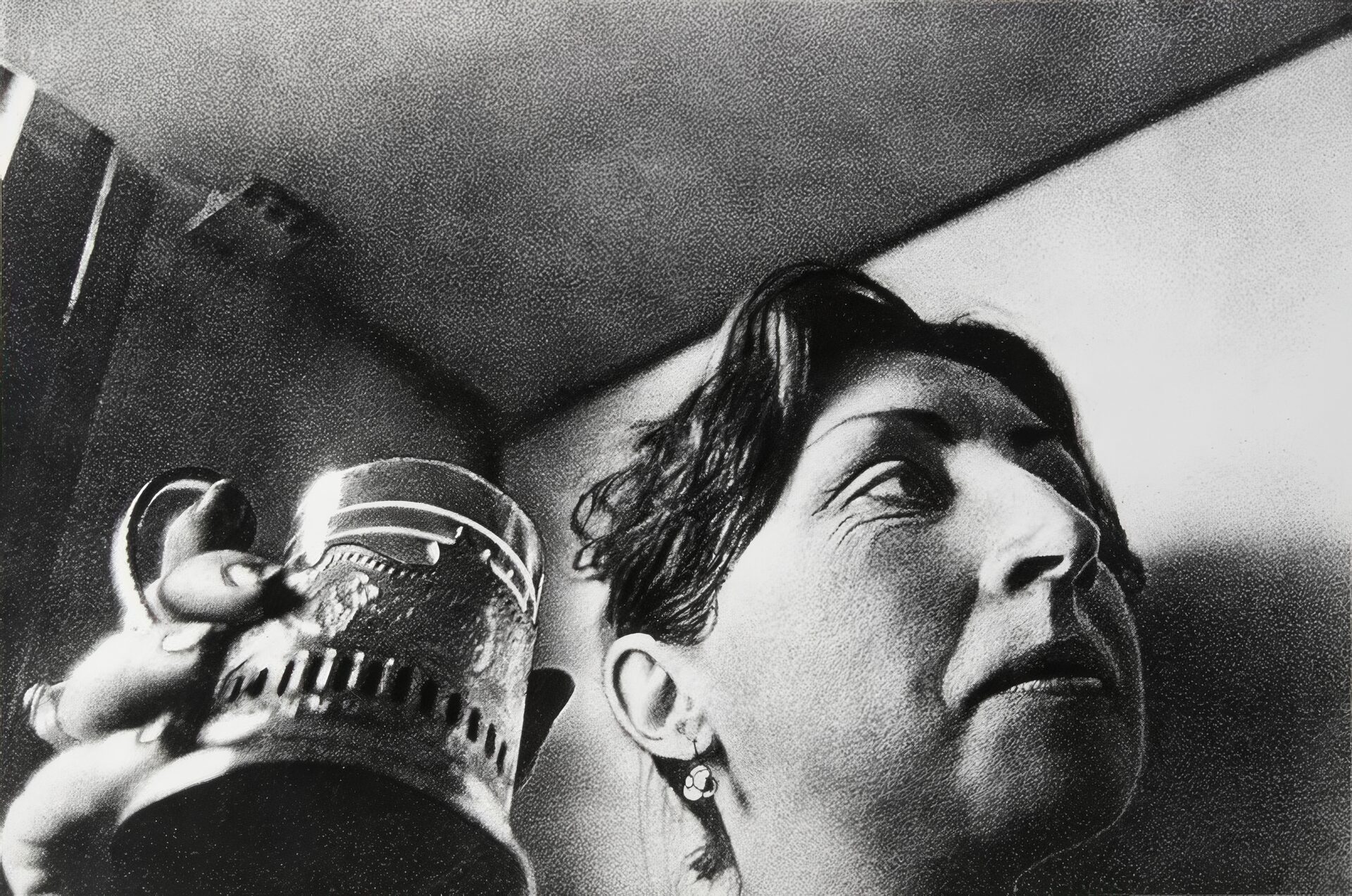
"There and Then".
Group photographic exhibition.
NOVA gallery of visual arts, Minsk.
November – December 1999.
Curator – Uladzimir Parfianok.
Common knowledge is that photography does not answer questions and, similarly, is not a question by itself. It exists away from kitchen-table conversations about the meaning of life, normally being a pure affirmation of reality in what we see. In this sense, photography represents the present in its authenticity, a concept defined by the famous ancient philosophical category hic et nunc (here and now) – the unity of "time and place."
The name of the exhibition "There and Then", which took place in the NOVA gallery, is obviously opposed to the "hic et nunc." The choice of topic for the exhibition project is somewhat ironical because although the original idea was to display travel impressions, "there and then" can also refer to one aspect of the current state of Belarusian photography. There and then something is happening that makes Belarusian photography exist. In Cambridge, in Austria, in Prague, on Spitzbergen archipelago, in Poland, in Russia's north, photographs' eye gets mobilized, learns to "see", as any of us placed in a strange environment.
Twelve photographers, which have nothing in common, except for a relative national photographic identity, displayed "modest charm" of the strange as a visual event.
What is that that allows photographs to go beyond the boundaries of "visual colonialism" by an ordinary tourist? First of all, intuition of the MEDIALITY of the environment, in which they found themselves. While mediality is obvious in the mutual transparence of spaces (achieved by means of making prints from two negatives put above each other) in Vladimir Shakhlevich's series shot in Berlin, the metaphoric montage at the juncture of frames in Uladzimir Parfianok's works better reflects the material effect of the shooting process itself as unification of objects separated in reality, with a view to create a new space. (In this respect, Parfianok can be called the most material Belarusian photographer).
Ships by Elena Mulyukina, chiaroscuro and water surfaces in Sergei Pilipovich's Prague series, and Cambridge landscape broken by a road in a photograph by Vadim Poteyev have a common feature of that being an experience of TRANSPARENCY of space and its strange and necessary transformation into something else. Stone crosses in the pictures by Victor Zhuravkov, as well as figures of saints with nimbuses by his colleague Sergei Zhdanovich symbolize this "something else".
"There and then" of Belarusian photographers destroys history, in a way, with space attacking time. This attack is equally noticeable in the retouched bourgeois Cambridge views, in works from the Chornaya Gancha series by Albert Tsekhanovich, in the photographs by Uladzimir Parfianok, in which the black stripe between consecutive frames symbolizes a time interval, or tries to stop time in the Sarcophagus series by Dzianis Ramanyuk. Stone crosses by Zhuravkov – the cross is nothing but an absolute symbol of space – show that space has become such an aggressive for Belarusian visual culture that it has absorbed time.
Romanyk's Sarcophagus reminds the knowledgeable viewer of Chernobyl-related projects by Vladimir Blinov, his wooden crosses with the sky in the background, a symbol of outer space emptiness. "All of that is in the past," wrote Blinov. "What is here now is people's solidified pain and remembrances of those who used to live here and a depressing feeling of loneliness, which are slowly eroding." The Chernobyl zone has become a metaphor for the erosion of the historical dimension of our life – an eternal "there and then."
At the same time, the miserable state of Belarusian culture makes the "there and then" state quite helpful for development of Belarusian photography. Being too much focused on reality has been a scourge of Belarusian photography in the last few years. While here and now photographers are only involved in calisthenics, "there and then" they are released from this sort of dependence.
Ironically, "here and now" is absolutely equal to "there and then." If there is no time, all categories are the same. How have we been able to deceive ourselves once again?
Dmitry Korol.
Translated by Vladimir Kozlov.
Group photographic exhibition.
NOVA gallery of visual arts, Minsk.
November – December 1999.
Curator – Uladzimir Parfianok.
Common knowledge is that photography does not answer questions and, similarly, is not a question by itself. It exists away from kitchen-table conversations about the meaning of life, normally being a pure affirmation of reality in what we see. In this sense, photography represents the present in its authenticity, a concept defined by the famous ancient philosophical category hic et nunc (here and now) – the unity of "time and place."
The name of the exhibition "There and Then", which took place in the NOVA gallery, is obviously opposed to the "hic et nunc." The choice of topic for the exhibition project is somewhat ironical because although the original idea was to display travel impressions, "there and then" can also refer to one aspect of the current state of Belarusian photography. There and then something is happening that makes Belarusian photography exist. In Cambridge, in Austria, in Prague, on Spitzbergen archipelago, in Poland, in Russia's north, photographs' eye gets mobilized, learns to "see", as any of us placed in a strange environment.
Twelve photographers, which have nothing in common, except for a relative national photographic identity, displayed "modest charm" of the strange as a visual event.
What is that that allows photographs to go beyond the boundaries of "visual colonialism" by an ordinary tourist? First of all, intuition of the MEDIALITY of the environment, in which they found themselves. While mediality is obvious in the mutual transparence of spaces (achieved by means of making prints from two negatives put above each other) in Vladimir Shakhlevich's series shot in Berlin, the metaphoric montage at the juncture of frames in Uladzimir Parfianok's works better reflects the material effect of the shooting process itself as unification of objects separated in reality, with a view to create a new space. (In this respect, Parfianok can be called the most material Belarusian photographer).
Ships by Elena Mulyukina, chiaroscuro and water surfaces in Sergei Pilipovich's Prague series, and Cambridge landscape broken by a road in a photograph by Vadim Poteyev have a common feature of that being an experience of TRANSPARENCY of space and its strange and necessary transformation into something else. Stone crosses in the pictures by Victor Zhuravkov, as well as figures of saints with nimbuses by his colleague Sergei Zhdanovich symbolize this "something else".
"There and then" of Belarusian photographers destroys history, in a way, with space attacking time. This attack is equally noticeable in the retouched bourgeois Cambridge views, in works from the Chornaya Gancha series by Albert Tsekhanovich, in the photographs by Uladzimir Parfianok, in which the black stripe between consecutive frames symbolizes a time interval, or tries to stop time in the Sarcophagus series by Dzianis Ramanyuk. Stone crosses by Zhuravkov – the cross is nothing but an absolute symbol of space – show that space has become such an aggressive for Belarusian visual culture that it has absorbed time.
Romanyk's Sarcophagus reminds the knowledgeable viewer of Chernobyl-related projects by Vladimir Blinov, his wooden crosses with the sky in the background, a symbol of outer space emptiness. "All of that is in the past," wrote Blinov. "What is here now is people's solidified pain and remembrances of those who used to live here and a depressing feeling of loneliness, which are slowly eroding." The Chernobyl zone has become a metaphor for the erosion of the historical dimension of our life – an eternal "there and then."
At the same time, the miserable state of Belarusian culture makes the "there and then" state quite helpful for development of Belarusian photography. Being too much focused on reality has been a scourge of Belarusian photography in the last few years. While here and now photographers are only involved in calisthenics, "there and then" they are released from this sort of dependence.
Ironically, "here and now" is absolutely equal to "there and then." If there is no time, all categories are the same. How have we been able to deceive ourselves once again?
Dmitry Korol.
Translated by Vladimir Kozlov.
Shrinking Roll Call Minsk.
Сreative Сamera. Issue 36.
December 1999.
Ирина Бигдай, Владимир Козлов.
"Там и Тогда". Статья из Сrative Сamera (in eng.)
In late October, a survey of Belarusian photography, There and Then, opened in Minsk's NOVA gallery.
Twelve artists took part in this latest survey show of Belarusian photography - almost half the number who participated in a similar show in the same gallery three years ago. The statistics could be explained by the problems faced by photography in Belarus. In addition to financial problems that hamper the development of all kinds of arts in Belarus, no university here offers an academic programme in photography, while NOVA remains the only specialised photographic gallery. As the photographer, Uladzimir Parfianok said, the exhibition's title is a hint at the situation in the Belarusian photography, which knew better times.
In the last ten years, a number of photographers from Minsk have achieved international recognition, which allowed critics to speak about the Minsk school of photography. Finnish photographer and curator, Hannu Eerikainen, was the first to use the term 'the Minsk School'. That happened around 1988, when Belarus was part of the Soviet Union and Belarusian photographers had the first opportunity to meet with Western curators. At that time several young Belarusian photographers gathered around their teacher Valery Lobko, and formed a group called The Province. Mostly they were engineers or architects by training, unable to realise their creative potential within the Soviet system. In the early nineties The Province group organised exhibitions in the United States, Germany and Scandinavian countries, and now most of its former members work independently, being Belarus's most famous photographers - such as Parfianok and Vladimir Shakhlevich who are both represented in There and Then.
As a representation of Belarusian photography, There and Then reveals that many photographers are emulating painting, but rather than using computer manipulation, they prefer traditional photographic techniques (such as sandwich printing and toning).
In late October, a survey of Belarusian photography, There and Then, opened in Minsk's NOVA gallery.
Twelve artists took part in this latest survey show of Belarusian photography - almost half the number who participated in a similar show in the same gallery three years ago. The statistics could be explained by the problems faced by photography in Belarus. In addition to financial problems that hamper the development of all kinds of arts in Belarus, no university here offers an academic programme in photography, while NOVA remains the only specialised photographic gallery. As the photographer, Uladzimir Parfianok said, the exhibition's title is a hint at the situation in the Belarusian photography, which knew better times.
In the last ten years, a number of photographers from Minsk have achieved international recognition, which allowed critics to speak about the Minsk school of photography. Finnish photographer and curator, Hannu Eerikainen, was the first to use the term 'the Minsk School'. That happened around 1988, when Belarus was part of the Soviet Union and Belarusian photographers had the first opportunity to meet with Western curators. At that time several young Belarusian photographers gathered around their teacher Valery Lobko, and formed a group called The Province. Mostly they were engineers or architects by training, unable to realise their creative potential within the Soviet system. In the early nineties The Province group organised exhibitions in the United States, Germany and Scandinavian countries, and now most of its former members work independently, being Belarus's most famous photographers - such as Parfianok and Vladimir Shakhlevich who are both represented in There and Then.
As a representation of Belarusian photography, There and Then reveals that many photographers are emulating painting, but rather than using computer manipulation, they prefer traditional photographic techniques (such as sandwich printing and toning).